
Celebrating Our 75th Anniversary!
Everything You Want To Know About Adus
AKA: Accessory Dwelling Units, Granny Flats, In-Law Suites, Guest House, 2nd Dwellings, Backyard House or Casita
Why the surge in conversations about ADU?
California has been in a serious shortage of affordable housing. To help alleviate the problem, as of January 1, 2017 California implemented a state mandate to loosen the restrictions on 2nd dwellings built on a homeowner’s property. Cities now have to loosen or revise their rules to adapt with the new regulations.
Accessory Dwelling Units (ADUs) or also known as granny flats, in-law suites, guest house, 2nd dwellings, backyard house or casita, have long had strict restrictions in some cities and areas throughout California. Some cities allowed ADUs to be built though there would be a long approval process that could take months. There were others cities in California that didn’t allow ADUs at all, no exceptions. With the shortage of affordable housing, California saw ADUs as the answer but had to place a mandate to get cities to act in the affordable housing crisis.
There were three separate pieces of California State legislation that took effect January 1, 2017, making it easier for homeowners to build ADUs. The new land use bills require cities to allow ADUs but also gives cities sovereignty to decide how homeowners can build ADUs based on a cities unique characteristics. The three bills introduced and signed by Governor Brown; SB 1069, AB 2299, and AB 2406 each make it easier for homeowners to take advantage of building ADUs.
What are the benefits of building an ADU?
- ADUs are affordable to construct because there is no need to buy a new piece of land to build on, but rather build more living space on the property you already own
- Our ADUs are built in a controlled factory environment using cost-efficient construction methods to save the homebuyer money
- ADUs can become a source of income for homeowners who rent out the ADU
- ADUs are a great way to have an independent living area for aging family members that may need assistance or other family/friends that need a place to live but want more privacy
What are the rules for ADUs?
- ADUs have a state wide maximum size of 1,200 sq.ft. for detached units but actual maximum size varies by city. This can be confusing but the legislation states cities are allowed to decided what blanket maximum size best suits their residents
– An example would be the City of Ventura versus the County of Ventura
– If you live in the County of Ventura regulated areas, your ADU can be a maximum 1,200 sq.ft.
– But, if you live in the County of Ventura and within the boundaries regulated by the City of Ventura, the max size ADU can be 750 sq.ft. Not only that but the ADU can’t be higher than 28ft, the property owner must also live on the property, and the homeowner can’t rent the ADU for a period of less than 30 days
– The best and EASIEST way to figure out what sized ADU is allowed on your property is to work with a permit processor who can do the leg work for you to figure out what size ADU is allowed. If you prefer to do it yourself, figure out if you are under city or county jurisdiction and contact them to ask. If you need the name of a good permit processor, please contact us!
- In most instances, ADU parking requirements have been eliminated if the home is less than ½ mile from a mass transit system
- If the ADU fits within the new state regulations, the ADU DOES NOT involve a use permit. Use permits are a zoning exception typical for projects that have potential for negative impacts on the surrounding neighborhood and often require public hearing. With no use permit needed it saves the buyer time and money under these new rules
- The ADU won’t require Planning Commission or City Council approval if the ADU fits within the State regulations
- Local communities can identify zones where the ADUs are permitted
- An ADU can be denied by the City or County if the ADU and property do not meet the City’s applicable development standards. Examples are the ADU won’t meet appropriate set backs from property lines or a certain percentage of property is already covered by structures thus the property won’t allow for another structure to be built
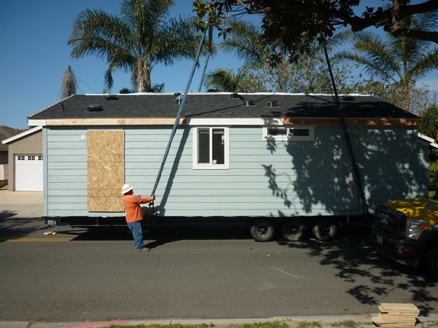
Granny Flat Getting Prepped For Crane
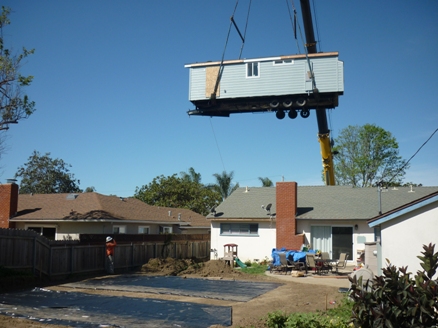
Granny Flat Being Craned Over Home
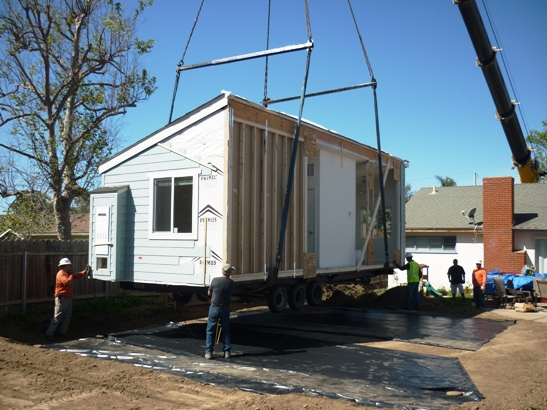
Manufactured Home ADU Getting Ready For Install
Backyard Home in Place Awaiting Final Set-Up
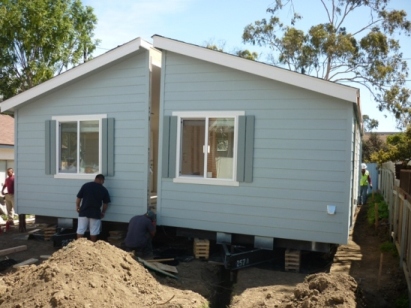
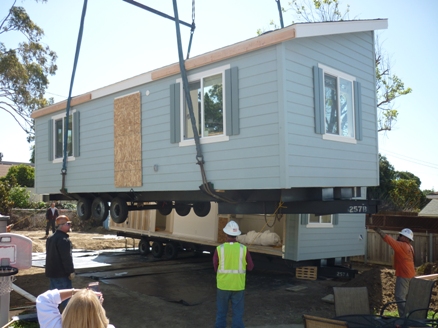
NOTE: Most ADU homes we install don’t need to be craned into place. This manufactured home was an exception.